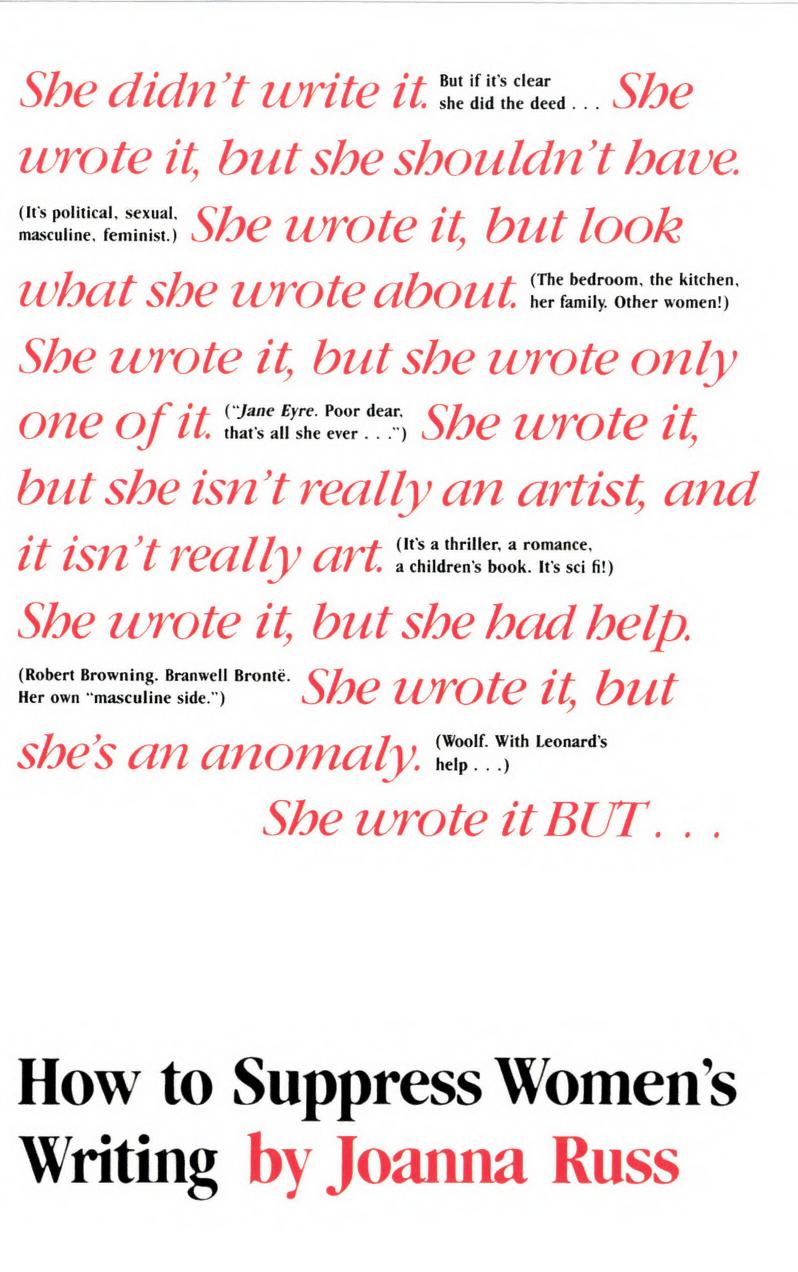
How to Suppress Women's Writing by Joanna Russ
Author:Joanna Russ [Russ, Joanna]
Language: eng
Format: epub, pdf
Publisher: University of Texas Press
Published: 1983-08-10T16:00:00+00:00
9. Lack of Models
MODELS AS GUIDES to action and as indications of possibility are important to all artists—indeed to all people—but to aspiring women artists they are doubly valuable. In the face of continual and massive discouragement, women need models not only to see in what ways the literary imagination has (as Moers says) been at work on the fact of being female, but also as assurances that they can produce art without inevitably being second-rate or running mad or doing without love. It is here that the false categorizing of artists into whores, sad spinsters, devoted submissive wives, and (recently) tragic suicides converges with the obliteration of the female tradition in literature to work the greatest harm.
It deprives the young of models.
At first glance, the lack of models and the assertion that there is a female tradition in literature seem contradictory. I think not. One difference is in the age of the women involved—female support groups exist but they must be created anew by each generation, so that what was missing during one’s formative years may (with luck and drive) be built or discovered later on at a considerable cost in time, energy, and self-confidence. I also suspect that higher education has had one bad effect not foreseen in the middle of the last century: an informal acquaintance with the common female tradition in literature has been replaced by a formal education which entirely omits it. In the former case the models and the tradition, though denigrated, were there. In the latter case all but a few anomalous women have become invisible. Thus Elaine Showalter writes:
Let us imagine a woman student entering college to major in English literature. In her freshman year . . . the texts in her course would be selected for their timeliness, or their relevance or their power to involve the reader. . . . any of the [recently advertised] . . . texts . . . for Freshman English . . . [like] The Responsible Man, “for the student who wants literature relevant to the world in which he lives,” or Conditions of Men, or Man in Crisis: Perspectives on the Individual and His World, or . . . Representative Men: Cult Heroes of Our Time, in which the thirty-three men represent such categories of heroism as the writer, the poet, the dramatist, the artist, and the guru . . . the only women included are the Actress Elizabeth Taylor and the Existential Heroine Jacqueline Onassis.
Perhaps the student would read a collection of stories like The Young Man in American Literature: The Initiation Theme, or sociological literature like The Black Man and the Promise of America . . . [or] she might study the eternally relevant classics, such as Oedipus; as a professor remarked in a recent issue of College English, all of us want to kill our fathers and marry our mothers. And . . . she would inevitably arrive at the favorite book of all Freshman English courses, the classic of adolescent rebellion, Portrait of the Artist as a Young Man.
Download
How to Suppress Women's Writing by Joanna Russ.pdf
This site does not store any files on its server. We only index and link to content provided by other sites. Please contact the content providers to delete copyright contents if any and email us, we'll remove relevant links or contents immediately.
4 3 2 1: A Novel by Paul Auster(12392)
The handmaid's tale by Margaret Atwood(7763)
Giovanni's Room by James Baldwin(7346)
Asking the Right Questions: A Guide to Critical Thinking by M. Neil Browne & Stuart M. Keeley(5775)
Big Magic: Creative Living Beyond Fear by Elizabeth Gilbert(5771)
Ego Is the Enemy by Ryan Holiday(5448)
The Body: A Guide for Occupants by Bill Bryson(5096)
On Writing A Memoir of the Craft by Stephen King(4944)
Ken Follett - World without end by Ken Follett(4732)
Adulting by Kelly Williams Brown(4574)
Bluets by Maggie Nelson(4556)
Eat That Frog! by Brian Tracy(4540)
Guilty Pleasures by Laurell K Hamilton(4449)
The Poetry of Pablo Neruda by Pablo Neruda(4108)
Alive: The Story of the Andes Survivors by Piers Paul Read(4033)
White Noise - A Novel by Don DeLillo(4010)
Fingerprints of the Gods by Graham Hancock(4004)
The Book of Joy by Dalai Lama(3986)
The Bookshop by Penelope Fitzgerald(3853)
